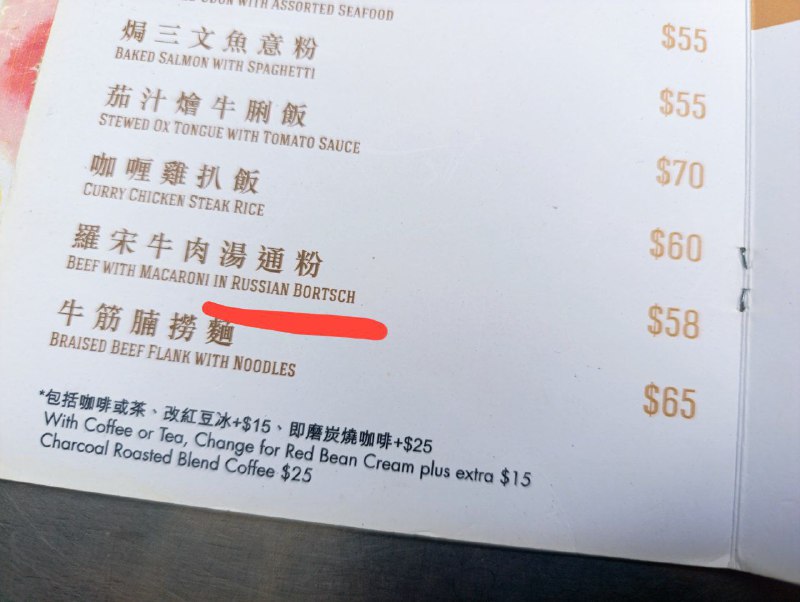
My discovery of the year in Hong Kong turned out to be borscht. Or rather, what the locals call borscht. When you search for 罗宋汤 on Google Maps, you'll find plenty of places to try this dish. You'll mostly have to choose from local Chinese canteens with ratings below 4. Sometimes they're disguised as Western cuisine adapted to local tastes, rather than catering to tourists.
Credit should go to the White émigrés. About 300,000 people from Russia moved to China after the Soviet Revolution. When the communists took power in China too, they had to urgently find new options. Hong Kong was one of the logical choices. The peak of emigration came in the 1950s. The British ran the city back then, and they weren't exactly thrilled with the newcomers. Nevertheless, there were so many Russian émigrés here that a Western restaurant was practically a synonym for a Russian restaurant. Over time, almost all of that wave of emigrants scattered to third countries, but borscht became firmly entrenched in the local menu.
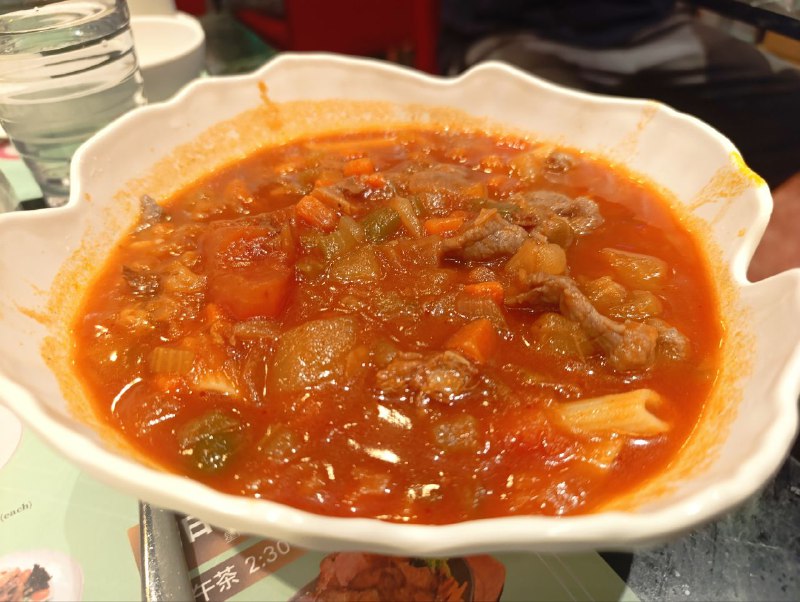
It was impossible to ignore such a phenomenon. I found it, tried it, and can honestly say that all that's left of borscht is its name. They brought me this tomato soup, and you can't even smell beets in it—and they threw in some pasta, though not everywhere adds that. There were so many tomatoes that it actually tasted a bit too sweet. Bread and sour cream don't come with this masterpiece. So even if you're craving that red soup more than the White émigrés were (no offense), this version won't help much. And if you Google the recipes, you can see how far Hong Kong's version has strayed from the original
I only checked out one place (cross it off your list :) ), but there are dozens around the city. There's a ghost of a chance that other places are better (unlikely). Maybe next time I'll work up the courage for a second attempt. But I wouldn't bet on it. Reality just diverged too far from my expectations this time.
Credit should go to the White émigrés. About 300,000 people from Russia moved to China after the Soviet Revolution. When the communists took power in China too, they had to urgently find new options. Hong Kong was one of the logical choices. The peak of emigration came in the 1950s. The British ran the city back then, and they weren't exactly thrilled with the newcomers. Nevertheless, there were so many Russian émigrés here that a Western restaurant was practically a synonym for a Russian restaurant. Over time, almost all of that wave of emigrants scattered to third countries, but borscht became firmly entrenched in the local menu.
It was impossible to ignore such a phenomenon. I found it, tried it, and can honestly say that all that's left of borscht is its name. They brought me this tomato soup, and you can't even smell beets in it—and they threw in some pasta, though not everywhere adds that. There were so many tomatoes that it actually tasted a bit too sweet. Bread and sour cream don't come with this masterpiece. So even if you're craving that red soup more than the White émigrés were (no offense), this version won't help much. And if you Google the recipes, you can see how far Hong Kong's version has strayed from the original
I only checked out one place (cross it off your list :) ), but there are dozens around the city. There's a ghost of a chance that other places are better (unlikely). Maybe next time I'll work up the courage for a second attempt. But I wouldn't bet on it. Reality just diverged too far from my expectations this time.
 United Kingdom
 Serbia
 Bosnia and Herzegovina
 Turkey
 United Arab Emirates
 Brunei
 Indonesia
 Malaysia
 Argentina
 USA
USA Morocco
 Georgia
 Egypt
Egypt Hong Kong
 China
China Vietnam
 Tunisia
 Montenegro
 Philippines
 Singapore
 Oman
Oman Algeria
 North Macedonia
 Lebanon
 Israel
 Albania
 Russia
 Tanzania
 Netherlands
 Spain
Spain Latvia
 Germany
 Belgium
 France
 Kazakhstan