Think Muslims can't be Orthodox or Catholic? On the Balkans — they can!
Here, Muslim isn't just someone who follows Islam, but also an ethnicity. These two groups of people don't overlap perfectly (though they do intersect).
Let's go back about 500 years. The Ottomans rule the Balkans. Many Bosnian residents change their religion. And they call themselves Turks. Of course, this had nothing to do with modern Turks—it meant belonging to Islam. If they needed to specify geography, they'd say they were Bosniak. Ethnicity didn't matter much back then.
By the end of the 19th century, the Ottomans were gone, and the word "Turk" was about to take on a different meaning. Austro-Hungary, which replaced the Ottoman Empire, decided to help BiH residents figure out their identity and declared everyone Bosniaks. It didn't stick: Bosnian Islamic intellectuals of that era often considered themselves (surprisingly) Serbs or Croats. What more can you say about everyone else? It's no coincidence that the Yugoslav Kingdom was initially called the Kingdom of Serbs, Croats and Slovenes.
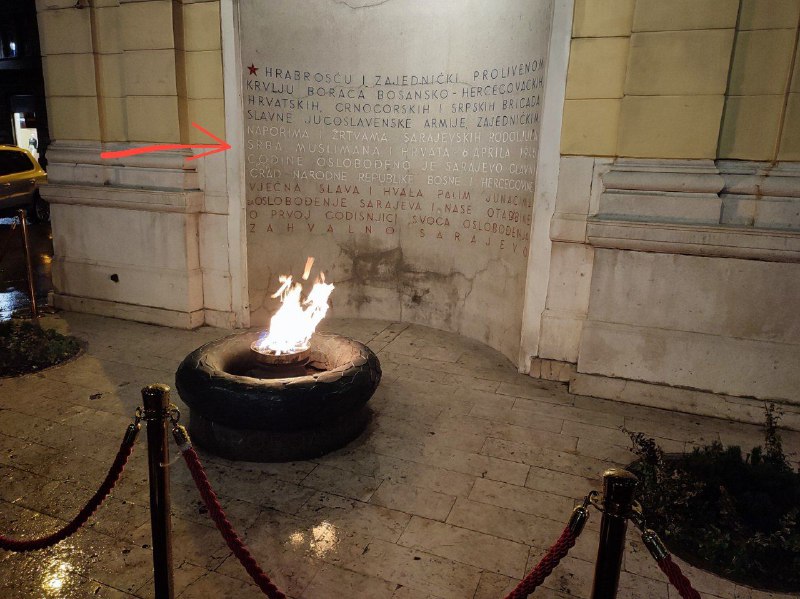
Around the same time, there were ideas floating around about dividing Bosnian lands between Serbia and Croatia. These changed how people thought about nationality. Separatist sentiments even emerged. But then came World War II, followed by communists. BiH became a separate republic within Yugoslavia, but the people living there still had no name. Most practiced Islam, so the party decided to call everyone Muslims. Regardless of religion. In the photo is an eternal flame in Sarajevo. That's where Muslims are a nationality.
After Yugoslavia fell apart, everything was redrawn again. All residents started being called Bosnians, while Bosniaks became the term for people whose ancestors converted to Islam under Ottoman rule. Though even now, everyone basically argues whether Bosniaks are Serbs and Croats who adopted Islam, or a separate people altogether. It's a very sensitive topic and can spark heated discussions. But you shouldn't count out Muslim nationality just yet: even today, tens of thousands of people on the Balkans identify with it.
Telegram mirror
Telegram is a messenger where I post short travel notes. This page is a self-hosted backup of that channel.
Countries
 United Kingdom3
 Serbia100
 Bosnia and Herzegovina54
 Turkey42
 United Arab Emirates3
 Brunei2
 Indonesia12
 Malaysia15
 Argentina16
 USA117
 Morocco5
 Georgia5
 Egypt16
 Hong Kong8
 China4
 Vietnam9
 Tunisia7
 Montenegro9
 Philippines12
 Singapore10
 Oman12
 Algeria12
 North Macedonia5
 Lebanon11
 Israel27
 Albania17
 Russia63
 Tanzania50
 Netherlands7
 Spain14
 Latvia2
 Germany7
 Belgium3
 France27
 Kazakhstan32